

Lau Ke Aloha
Lāʻau Love: Pollinators & Wellbeing
Gathering to create native species-inspired art
July 23, 2026 | 4:00 pm - 6:00 pm | Hale Pili

July 23, 2026 at Mākena Golf & Beach Clubʻs Hale Pili
Time: 4 p.m. - 6 p.m.
This free, family-friendly gathering invites our Maui community to create art inspired by the native plant life of Maui and Honuaʻula. Led by local artisans, each hands-on session centers on a unique aspect of our native ecosystem. This gathering is designed to connect more deeply with place through hands-on learning that strengthens pilina with ʻāina in the Honuaʻula moku.
Trusting the Plants, Seeding the Future
Each Lau Ke Aloha gathering honors select nonprofit organizations on Maui.
In preparation, each nonprofit chooses a native species important to itʻs vision and mission.
These gatherings are designed to remind us that we can trust our native species to help us seed the future. And to uplift and raise awareness of the important work of our local nonprofits.
Join us on July 23 for our Lau Ke Aloha gathering to create, connect, and celebrate the efforts of Nā Hale O Maui, Lahaina Community Land Trust, & Hawaiʻi Land Trust!

Meet the Artisans
Hoʻōla Honey
Ho‘ōla is a Native Hawaiian ʻohana based on Hawaiʻi Island with a mission to protect honey bees, strengthen food sovereignty, and help communities thrive alongside ʻāina. Since 2016, they have rescued over 300 bee colonies and relocated them to North Kohala. Their bees now pollinate local farms and gardens, while Ho‘ōla creates healing honeys infused with lāʻau, Hawaiian plant medicine, to nourish the lāhui and support families in bringing food medicine into everyday life.
Art Session
4:00 – 6:00 P.M.
Limited Spaces Available
Hana Noʻeau
Led by Hoʻōla Honey

Nā Hale O Maui
Nā Hale O Maui is Maui’s first community land trust and a nonprofit 501(c)(3) organization dedicated to securing and preserving permanently affordable homeownership opportunities for low- and moderate-income households in Maui County. Founded in 2006, the organization develops and stewards homes that remain affordable for generations, helping Maui residents build stability and remain part of the community.

Lahaina Community Land Trust
The Lahaina Community Land Trust is a 501(c)3 nonprofit formed in the fires’ aftermath to ensure that Lahaina’s lands remain forever in the hands of its people. To learn more, visit lahainacommunitylandtrust.org or follow us on social media at @lahainacommunitylandtrust.

Hawaiʻi Land Trust
Hawai‘i Land Trust (HILT) is Hawai‘i’s local statewide nonprofit land trust that protects, stewards, and cultivates reciprocal relationships with ʻāina that sustain Hawai‘i. The nationally accredited land trust supports the health, productivity, and resilience of Hawai‘i’s biocultural ecosystems, food systems, and kama‘āina and local communities through its 8 community preserves, 54 conservation easements, and ‘āina transactions, stewardship and community programs. For more, visit HILT.org.
The Plants That Gather Us
In a reciprocal relationship of aloha with our native species, they also gather us
All ʻuhaloa, ʻākulikuli, and nalo meli maoli inspired art submitted benefits the following Maui organizations:
Species featured by Nā Hale O Maui, Lahaina Community Land Trust, & Hawaiʻi Land Trust

Lahaina Community Land Trust
ʻUhaloa
Medicine often presents itself in the places and seasons where it's needed most. In Lahaina, after the fire, ʻuhaloa is often the first and most prevalent plant to grow through the gravel. ʻUhaloa is gentle yet powerful medicine for our respiratory system, and folks in Lahaina are still struggling with the after-effects of the fire on their lungs, and frankly, just to breathe through the stress and trauma.
The ʻuhaloa growing in Lahaina is healthy, abundant, and serves as a reminder that 'āina provides healing, and that breath is an important part of that.

Hawaiʻi Land Trust
ʻĀkulikuli
We find a connection to ʻĀkulikuli because it’s a great stabilizer for sand dune ecosystems (similar to the ones found on some of HILT’s community preserves), can be found all over the pae ʻāina (just like us), and itʻs edible and has medicinal uses (bonus!).

Nā Hale O Maui
Nalo Meli Maoli
We’re inspired by Hawaiʻi’s native yellow-faced bee, a small but essential pollinator whose quiet work sustains entire ecosystems. Like the bee, Nā Hale O Maui’s superpower is long-term stewardship, creating permanently affordable homeownership that allows families and communities to thrive for generations.

Mākena Golf & Beach Club
ʻAwa
ʻAwa- Commonly known as a medicinal plant for stress and muscle pain, we invoke the kinship of this plant along with Kane and Kanaloa to cultivate relationships with organizations that hold ʻāina in trust. We recognize that one cannot simply hold land; rather, laborious contributions must be made to nurture healthy spaces for ʻāina and kānaka to thrive. The kiʻi, the image, is a kānoa full of the freshly squeezed ʻawa, inviting one to a relaxed space for communication, path setting, and reflection.
How to Get Started


"Pay Attention" & "Watch Each Other"
These are the values weʻve learned in Honuaʻula by traveling with groups like the Protect Kahoʻolawe ʻOhana - pay attention and watch each other. Although when uttered on Kahoʻolawe, the phrases often come out sounding a little closer to "pay-ten-shen" and "watch-eech-chadda." At once avenues for personal and group safety, as well, pathways into the soul. In a Hawaiʻi worldview, there is no separation between the soul of the human and the soul of honua, the earth. The Hawaiian practice of Kilo, "to watch or look earnestly at for the purpose of discovering something," is to pay attention to how life is expressing itself in your landscape. When we watch and look carefully at the external environment, and return to this practice often, you just might realize that the external ecosystem beyond your skin is not separate from whatʻs happening inside your skin. Simply, no more difference.
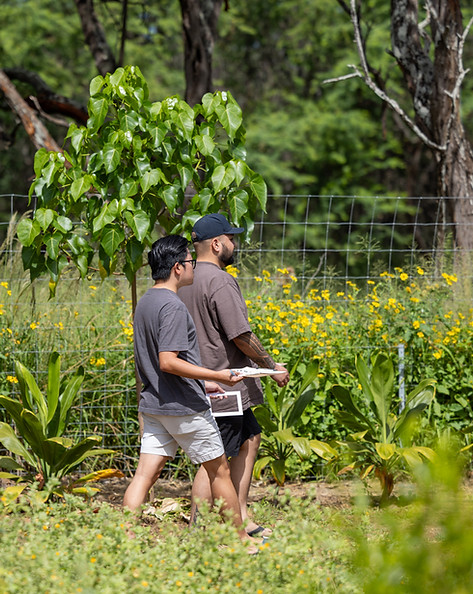
Lau Ke Aloha
May 10, 2025
Featured Nonprofits: Hui Noʻeau and Maui Nui Botanical Gardens
The Plants that Gathered Us: Naupaka papa (Scaevola coriacea)
Kalo (Colocasia esculenta)
Kupukupu (Nephrolepis cordifolia)
Koa (Acacia koa)
Koaiʻa (Acacia koaia)
Hala (Pandanus tectorius)
Hala pepe (Chrysodracon hawaiiensis)
Nehe (Wollastonia integrifolia)
Lau Ke Aloha
June 25, 2025
Featured Nonprofits: Lahaina Community Land Trust and Hawaiʻi Land Trust
The Plants that Gathered Us: ʻIlima (Sida fallax)
ʻUlu (Artocarpus altilis)
Koʻoloaʻula (Abutilon menziesii)
Lama (Diospyros sandwicensis)
Loulu (Pritchardia)
Pili (Heteropogon contortus)
Lau Ke Aloha
August 17, 2025
Featured Nonprofits: Uhiwai o Haleakalā and Mālama Kahālāwai
The Plants that Gathered Us: Lobelia gloria-montis
Koa (Acacia koa)
Wiliwili (Erythrina sandwicensis)

Queries to support your Kinolau journey:
-
Learn all your selected native plantʻs names:
-
the Hawaiian name(s), the common name, and the scientific name. What does its Hawaiian name mean?
-
-
Where and how does the species grow:
-
What aspect of its growth process and life cycle reflects your experience of life right now?
-
What catches your eye or heart about its coloring, patterning, or even smell?
-
-
What are some of the species "superpowers"?
-
How do their superpowers help you today?
-
-
Why is the species significant to its ecosystem?
-
Why is the species significant to you?
-
-
How is knowing this kinolau useful to your well-being and ʻāina well-being?
Here are some places we love to learn more about native species:
Hui Ku Maoli Ola